
In today’s high-stakes business world, executive burnout has emerged as a silent epidemic, especially among high-performing leaders. Despite outward markers of success, corner offices, accolades, and industry influence, many quietly battle exhaustion, disillusionment, and disengagement. Moreover, the relentless chase for traditional success metrics has created a troubling paradox: professionals at the top of their game are often the most affected by executive burnout.
Importantly, this isn’t merely a personal struggle; it’s a widespread structural issue. According to a recent Forbes article, burnout among senior leaders is rising sharply, with symptoms often overlooked until it’s too late. Similarly, a Deloitte report found that 70% of executives are seriously
considering departure due to burnout and poor alignment with their core values. Consequently, when executive burnout goes unaddressed, it can lead to poor decision making, low morale, and significant organizational setbacks, challenges that high-performing leaders must tackle head on.
By acknowledging the realities of burnout and redefining what sustainable leadership looks like, companies can begin turning the tide toward healthier leadership outcomes.
- Forbes on burnout among high‑performing leaders: The Silent Burnout Epidemic: How Leaders Can Spot and Prevent It
- Deloitte insights on leadership well-being: Executive Burnout Is the Hidden Crisis No One Wants to Talk About
The Hidden Cost of Success
Executive burnout is a mounting concern in high-performing environments. Firstly, executives, especially high-performing leaders, are often driven by ambition and a relentless pursuit of success, which can leave them running on empty. Their intense drive, although instrumental to business growth, can push them past sustainable limits. This so-called “overachiever syndrome” isn’t a reflection of personal weakness; it’s a structural issue deeply rooted in how modern organizations define success. Indeed, research from leadership development experts indicates that executive burnout stems not merely from workload, but from chronic misalignment between personal values and daily responsibilities.
Moreover, the consequences of burnout reach far beyond the individual. Studies show that burned-out executives are more likely to make poor decisions, suffer from creative stagnation, and struggle to motivate their teams. This disengagement often spreads through the organization, harming morale, performance, and employee retention. Industry surveys suggest that burnout among leaders disrupts knowledge continuity and drives turnover, a pressing concern for high-performing leadership teams. Therefore, addressing executive burnout is not optional; it is essential for building resilient, future-ready leadership teams.
- Leadership misalignment & burnout: Forbes on misalignment burnout: When Your Job Isn’t Your Purpose
- Burnout structural drivers: LinkedIn/Deloitte’s insights: From Burnout to Breakthrough
- Organizational impact of leadership burnout: Seramount article: Burnout Is a Leadership Crisis
Rethinking Success: From Metrics to Meaning
The conventional model of success, power, prestige, and profit, is increasingly under scrutiny. In response to growing awareness around executive burnout, many leaders are shifting toward a more holistic vision of success: one that includes purpose, personal well-being, and emotional richness. When executives redefine what success looks like, they often unlock not only deeper fulfillment but also greater impact.
This mindset shift isn’t soft; it’s strategic. Executives who lead with clarity, balance, and authenticity are better positioned to combat executive burnout and build adaptive, human-centered organizations. Their presence becomes not just more powerful, but more sustainable, an essential trait in today’s unpredictable business climate.
Strategies for Sustainable Leadership
Here are five actionable shifts executives can make today:
- Prioritize Well-being: Treat physical and emotional health as non-negotiable. Regular exercise, mindfulness, and proper rest are not luxuries; they are leadership essentials.
- Set Clear Boundaries: Guard your time and attention. A healthy separation between work and life promotes clarity, creativity, and resilience.
- Align with Purpose: Reconnect with the “why” behind your work. Purpose-driven leaders make better decisions and experience less burnout.
- Foster Authentic Relationships: Build a support network of peers, mentors, and coaches who offer honest feedback and meaningful connection.
- Empower and Delegate: Let go of control to build capacity. Empowering others enhances leadership impact and lightens the cognitive load.
Organizations must support these changes by building cultures that value well-being, not just output. Leadership is a long game, one that thrives on presence, not just pressure.
A New Paradigm for Executive Leadership
Success is no longer about being the busiest person in the room. It’s about being the most grounded, the most purpose-aligned, the most human. By embracing a more expansive, integrated definition of success, today’s executives can lead not just with power, but with purpose, and enjoy the lives they’ve worked so hard to create.
Who Are You Without the Title?
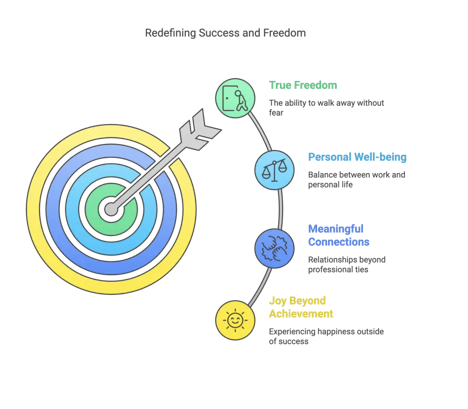
Take away your role, your LinkedIn headline, your corner office….. what is left?
This is the uncomfortable, necessary question every executive must confront: Is my identity rooted in who I am, or what I do?
Many find that their sense of worth has become dangerously entangled with their job. Fulfillment, however, does not come from titles. It comes from meaning, connection, and presence.
Ask yourself:
- Beyond leadership, what passions or values have I sidelined?
- Have I allowed work to shape my availability more than my priorities?
- If I lost my career today, would I still know who I am?
These are not philosophical indulgences. They are the foundation of sustainable leadership.
The Paradox of Control
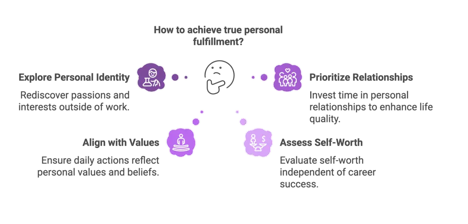
In the boardroom, executives excel at control. Strategy, structure, and precision define their day-to-day. But in their personal lives, this same approach often backfires.
You cannot optimize your marriage with KPIs.
You cannot delegate emotional well-being.
You cannot out-negotiate burnout.
Control, when applied everywhere, becomes a trap. What truly matters? connection, rest, love and all requires vulnerability, not spreadsheets.
True leadership requires surrender in the right places and the courage to recognize where control is a defense mechanism, not a solution.
The Five Currencies of Real Wealth
High-performing professionals often measure wealth by one currency: money.
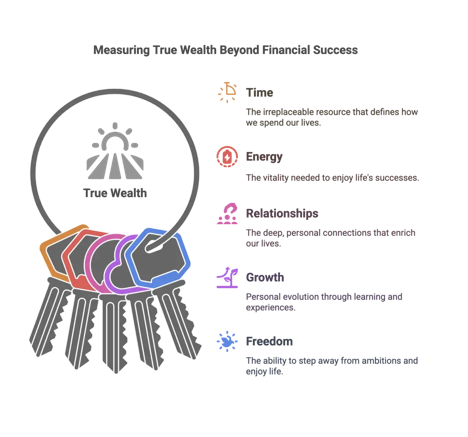
But at the top levels of leadership, five currencies determine how rich your life actually feels:
- Time, the one asset you cannot recover. Are you spending it intentionally?
- Energy, whether you are constantly drained, or your energy is replenishing what you invest in.
- Relationships, asking whether you are connected deeply or only professionally.
- Growth, the kind that extends beyond business metrics into spiritual, creative, and emotional development.
- Freedom, your ability to truly step away, instead of being imprisoned by your own ambition.
Money without these is hollow. Power without peace is a burden.
The Art of Having It All | Without Losing Yourself
High achievers are masters of strategy. But how many apply that same thinking to their personal life?
It is time to flip the script:
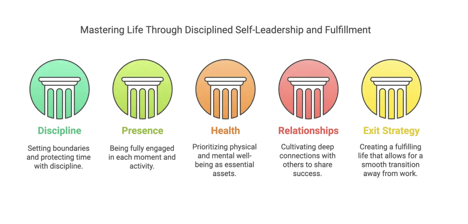
- Set Boundaries with Intention
Not all availability is valuable. Protect your life the same way you protect your business. - Prioritize Presence
Compartmentalize with purpose. When you are home, be fully home. - Care for the Asset You Are
You would not run a billion-dollar business without maintenance. So why do that to your body? - Invest in Relationships
Legacy is not about what you build. It is about who you impact. - Design Your Exit Strategy
Build a life rich enough that walking away does not feel like collapse. It feels like transition.
A New Definition of Executive Success
Imagine starting your day not with dread or depletion, but with clarity and internal purpose. Instead, picture a career that enhances your peace rather than compromising it. This is a version of success that energizes instead of exhausts. This vision represents the evolution of leadership for high-performing leaders.
Furthermore, executive burnout and fulfillment are no longer opposing forces. Today’s most effective leaders recognize that integration, not sacrifice, is the key. Indeed, they are not just scaling companies; they are scaling themselves. By leading with self-awareness, operating from balance, and defining success in more human terms such as joy, presence, and purpose, they model a new standard that inspires others.
After all, when your career comes to a close, no one will focus on your last quarterly earnings call. Rather, they will remember how you lived, how you led, and how you made others feel. So, did you show up fully? Were you intentional? Were you whole?
Further Reading:
- Harvard Business Review on holistic leadership: Leaders Need to Take a Holistic Approach
- Deloitte on leadership burnout and well‑being: Addressing the Shrinking Leadership Pipeline
- Research on leader integration & fulfillment: Impact of Leadership on Burnout & Fulfillment
Legacy Starts Now
The leaders who confront burnout head-on are reshaping what leadership looks like in the modern world. They are not just improving output; they are redefining outcomes. These are the leaders who create cultures of trust, wellness, and meaning, where people thrive, not just perform.
Ask yourself:
What legacy are you building?
Will it be measured in profits alone, or in the depth of your impact as a whole, grounded human being? Will it reflect a life driven by metrics, or by meaning?
True legacy is not built in boardrooms or balance sheets. It is built in moments of connection. It is grounded in clarity. It is forged through courage.
The time to redefine success and reclaim your life is not down the road. It is now.
Lead yourself well, and everything else will follow.