
The Invisible Weight of Constant Decision-Making
To illustrate, imagine an executive experiencing burnout, beginning the day already mentally exhausted. They face an overflowing inbox, back-to-back strategy meetings, and a relentless stream of decisions. Unfortunately, this scenario is all too common in today’s corporate world, where leaders are expected to make numerous critical decisions each day under constant pressure. Over time, this unrelenting demand can lead to decision fatigue, a psychological phenomenon that deteriorates decision quality and contributes significantly to executive burnout.
The Mental Cost of Leadership: Understanding Decision Fatigue
What Is Decision Fatigue?
By definition, decision fatigue refers to the decline in decision quality after a person has made many decisions. At its core, it is based on the concept that the human brain has a finite capacity for decision-making each day. When that capacity runs low, especially in high-pressure environments, executives may experience impaired judgment, procrastination, or impulsivity. These are symptoms that often contribute to or worsen executive burnout.
Psychological Underpinnings
The theory of ego depletion, introduced by psychologist Roy F. Baumeister, suggests that self-control and decision-making rely on a limited pool of mental resources. When this pool becomes depleted, the ability to make sound decisions begins to decline. This effect can be especially harmful in high-stakes leadership roles and is closely associated with the onset of executive burnout.ders, this impact often goes unnoticed until it begins to erode performance and relationships.
Manifestations in Executives
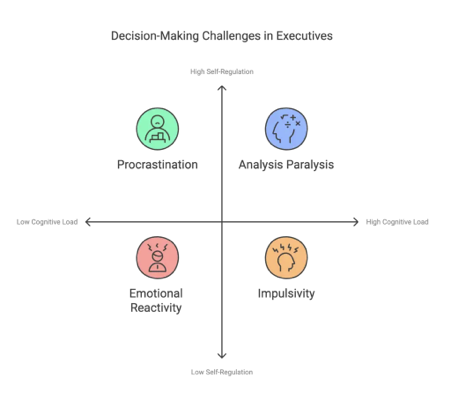
Executives experiencing decision fatigue may exhibit the following behaviors:
- Emotional Reactivity: Responding to challenges with heightened emotions due to diminished self-regulation.
- Impulsivity: Making hasty decisions in an attempt to quickly reduce mental pressure.
- Procrastination: Delaying decisions due to cognitive overload or mental exhaustion.
- Analysis Paralysis: Overthinking or overanalyzing situations to the point where no decision is made.
The Hidden Costs of Decision Fatigue in Business and Leadership
Impact of Executive Burnout on Organizational Performance
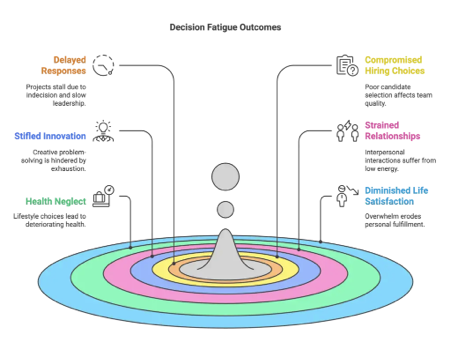
Executive burnout, often driven by decision fatigue, can significantly affect business operations:
- Delayed Responses: Critical projects may stall as leaders struggle to make timely decisions.
- Compromised Hiring Choices: Mental fatigue can impair judgment, leading to poor candidate selection.
- Stifled Innovation: Exhaustion reduces the capacity for creative thinking and long-term strategy.
Personal Repercussions of Executive Burnout
On an individual level, decision fatigue can directly lead to executive burnout, which may result in:
- Diminished Life Satisfaction: A constant sense of overwhelm may erode a person’s sense of purpose and fulfillment.
- Strained Relationships: Limited mental energy affects communication and connection with others.
- Health Neglect: Ongoing fatigue can lead to unhealthy lifestyle choices and reduced well-being.
The Solution: Leveraging Digitalization to Alleviate Decision Fatigue
Implementing Technological Solutions
Digital tools can play a pivotal role in reducing the cognitive load that contributes to executive burnout:
- AI-Powered Analytics: Using artificial intelligence to process complex data sets provides clear, actionable insights that reduce decision fatigue.
- Automated Workflows: Automating routine tasks reduces the number of decisions leaders must make, easing mental strain.
- Centralized Dashboards: Combining key performance indicators into a single interface enables quicker assessments and informed decision-making while minimizing information overload.
Case Studies
Smart systems implemented across operations can significantly reduce the mental burden that leads to executive burnout:
- Fleet Management Optimization: AI-driven reporting systems provide real-time data on vehicle use and maintenance, helping executives make proactive decisions and reducing mental fatigue.
- Enhanced Business Intelligence: Unified dashboards that aggregate cross-departmental data offer a clear view of performance, improving strategic decision-making.
- CRM System Automation: Automating tasks such as lead scoring and follow-ups allows leaders to concentrate on high-impact work instead of repetitive processes.
Strategies for Executives to Combat Decision Fatigue
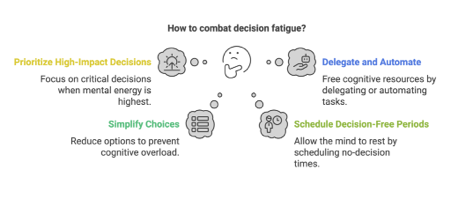
- Prioritize High-Impact Decisions: Make the most important decisions during peak energy hours, typically early in the day.
- Delegate and Automate: Identify decisions that can be handled by trusted team members or supported by technology to preserve mental energy.
- Simplify Choices: Reduce the number of options in routine decisions by standardizing workflows, meeting times, or approval processes.
- Schedule Decision-Free Periods: Designate parts of the day where no decisions are made to give your mind a break and encourage clarity.
- Implement Regular Breaks: Short, consistent breaks throughout the day help restore focus and improve overall decision quality.
From Overload to Clarity: Elevating Executive Performance in the Digital Era
In today’s hyperconnected environment, the executive mind is under constant siege. Notifications, meetings, emails, and rapid decisions create a relentless mental churn that few leaders are trained to manage. As a result, clarity, strategic focus, and emotional bandwidth erode over time, the hallmarks of decision fatigue and major contributors to executive burnout.
Importantly, this is not a failure of discipline or ambition; it is biology. The executive brain is not engineered for infinite choices or endless inputs. It is built for discernment, prioritization, and visionary thinking. When consumed by minutiae, even the most capable leaders experience diminished cognitive performance, poor judgment, and, ultimately, executive burnout.
Mental Energy Is a Strategic Asset
Research on ego depletion and cognitive overload makes one thing clear: mental energy is a finite resource. Each time a decision is made, no matter how trivial, it draws from this reservoir. Without systems to conserve and direct that energy, leaders risk spending their best thinking on the least important problems, accelerating the path to burnout.
In response, smart leaders now treat mental clarity the way elite athletes treat physical conditioning: as a non‑negotiable part of performance. Instead of optimizing for more productivity, they design their days, teams, and technologies around better thinking, an essential mindset shift in preventing burnout.
Digitalization: From Distraction to Decision Support
Contrary to popular belief, technology is not the enemy of clarity; it amplifies it. Used intentionally, digital tools filter noise, automate routine tasks, and surface insights that enable faster, higher‑quality decisions.
The future‑ready executive does not merely adopt technology; they integrate it as a strategic extension of their mind. By doing so, they implement tools that reduce decision fatigue, simplify complex processes, and create space for deep, reflective thinking. Ultimately, digitalization becomes less about efficiency and more about cognitive leverage, a key factor in preventing executive burnout.
Leadership Is the Integration Layer
Modern leadership is no longer about heroic decision‑making. It is about architecting an environment where excellent decisions become inevitable, and about serving as the integration layer between technology, people, and purpose.
This shift requires moving from reactive to intentional leadership, where mental bandwidth is protected, not depleted. In this model, daily operations are shaped by design, not chaos. Clarity, not busyness, becomes the benchmark of effectiveness and a safeguard against burnout.
Pause and ask yourself:
- Are your systems designed to enhance your executive clarity, or drain it?
- Are you optimizing for value‑creating decisions, or getting stuck in the weeds?
- Are you consciously leading your organization, or unconsciously reacting to it?
The New Paradigm: Leading with Cognitive Intent
In this paradigm, success belongs to leaders who recognize that their greatest asset is not time or effort, but attention. By reclaiming mental bandwidth, they drive sharper strategy, foster deeper connection, and achieve sustainable performance, not just for themselves but across the organization.
In today’s world, clarity is no longer a luxury; it is a competitive advantage.
You don’t need more input. You need more insight.
And that shift begins here: stop thinking more. Start thinking better.
Resources
- The Burnout Crisis – Harvard Business Review: Explores how burnout is affecting leaders and what organizations can do to address it.
- Decision Making in the Age of AI – McKinsey & Company: Discusses the cognitive burden on leaders and how digital tools can enhance decision quality.
- The Future of Leadership: Redefining Success – Forbes: Covers how modern leadership is evolving to prioritize purpose, well-being, and sustainable performance.
- The Hidden Costs of Decision Fatigue – APA: Details the psychological impact of decision fatigue and its link to burnout.
- What Burnout Does to Your Body – Mayo Clinic: A medical look at how chronic stress and burnout affect physical health.